
SEDGEHAMMER PRODUCT INFO
SedgeHammer® Turf Herbicide
A label-based reference for the 75% water-dispersible granule formulation supplied in a bottle with a 0.9 gram measuring scoop.
This is the scoop-and-bottle formulation
This page applies to SedgeHammer® with 75% halosulfuron-methyl and EPA Reg. No. 81880-1-10163. It does not apply to SedgeHammer®+ 5% pouches.
New York registration check
Before application in New York, confirm EPA Reg. No. 81880-1-10163 and the currently accepted label in NYSPAD. Use the label attached to the product in hand.
Halosulfuron-methyl, 75.0%
Water-dispersible granule formulation.
CAUTION
Causes moderate eye irritation. Harmful if swallowed.
81880-1-10163
Halosulfuron-methyl Group 2 herbicide.
Post-emergence
Commercial and residential turf, established lawns, ornamental turfgrass, and landscaped areas.
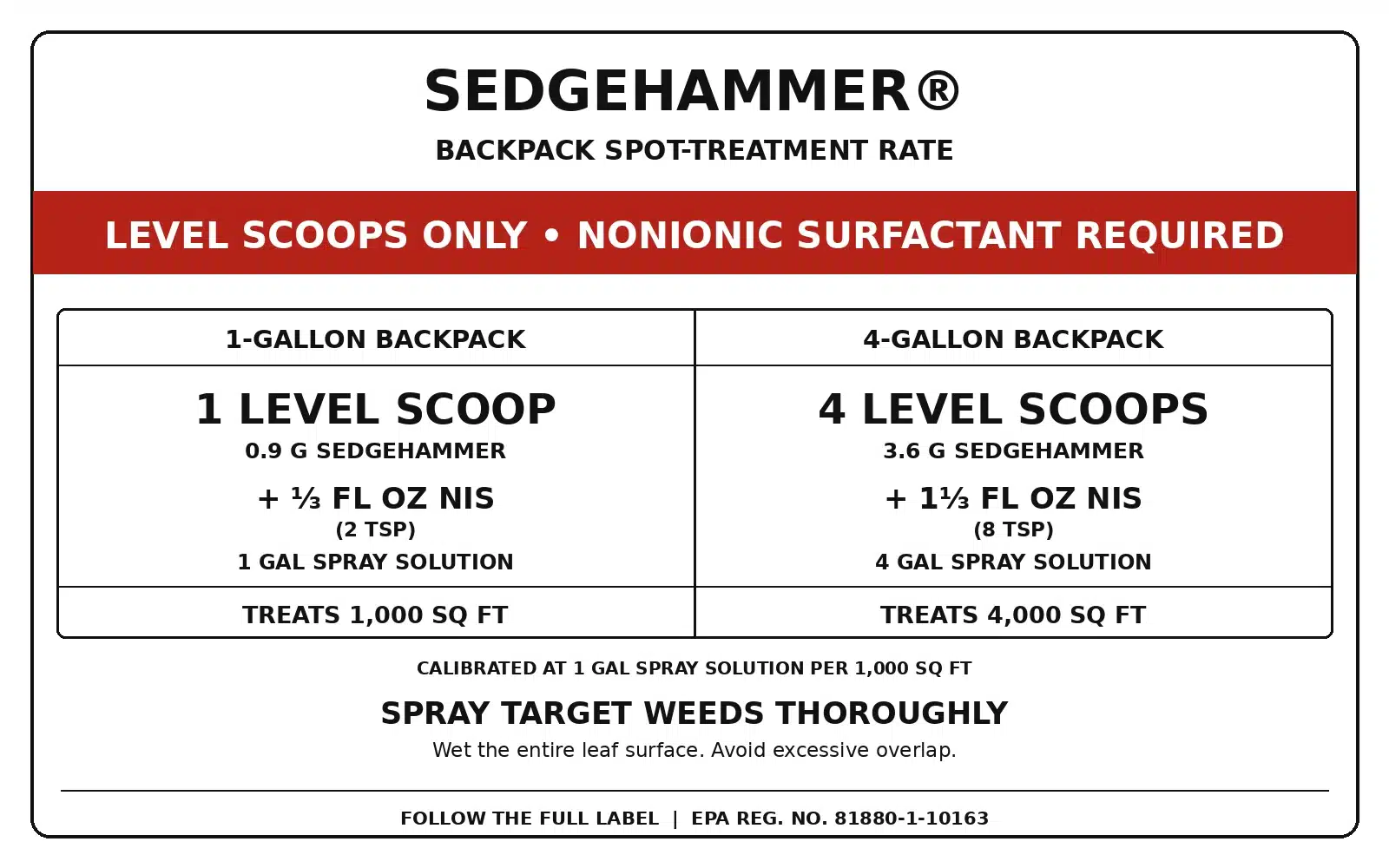
One level 0.9 g scoop
Use the measuring scoop provided. Do not round the scoop.
After spray has dried
Keep people off treated areas until the spray solution has dried.
Residential lawn use
SedgeHammer® is labeled for post-emergence control of nutsedges and listed broadleaf weeds in established lawns, commercial and residential turf, ornamental turfgrass, and landscaped areas.
Apply to well-established turfgrass with a good root system and uniform stand. Avoid application when turfgrass or nutsedge is under stress because turf injury and poor nutsedge control may result.
3 to 8 leaf stage
A second treatment may be applied six to ten weeks after the initial treatment.
Bottle and scoop dilution rate
| 1-gallon product rate | 1 level scoop, 0.9 gram |
|---|---|
| 1-gallon NIS rate | 1/3 fl oz, or 2 teaspoons |
| 1-gallon coverage | 1,000 sq ft at the displayed calibration |
| 4-gallon product rate | 4 level scoops, 3.6 grams total |
| 4-gallon NIS rate | 1 1/3 fl oz, or 8 teaspoons |
| 4-gallon coverage | 4,000 sq ft at the displayed calibration |
| Label carrier range | 1 or 2 gallons of water per 1,000 sq ft |
| Scoop | Level, not rounded |
Nonionic surfactant is required
The bottle formulation does not contain the surfactant supplied in SedgeHammer®+. For spot treatment, the label specifies two teaspoons, or one-third fluid ounce, of nonionic surfactant per gallon of water. Do not substitute the separate MSO rate for this required NIS rate, and do not exceed the labeled surfactant amount.
Application checklist
- Calibrate the application equipment before application.
- For a one-gallon load, measure one level 0.9 gram scoop.
- For a full four-gallon backpack, measure four level scoops, totaling 3.6 grams.
- Add two teaspoons, or one-third fluid ounce, of nonionic surfactant for every gallon of water.
- A full four-gallon backpack uses eight teaspoons, or one and one-third fluid ounces, of nonionic surfactant.
- Apply uniformly, spray target weeds thoroughly, and wet the entire leaf surface.
- Avoid excessive spray overlap.
Post-emergence weed activity listed on the label
The label classifies post-emergence activity as control, suppression, or no activity.
Control
- Common cocklebur
- Corn spurry
- Rice flatsedge
- Philadelphia fleabane
- Galinsoga
- Annual Kyllinga
- Green Kyllinga
- Ladysthumb
- Venice mallow
- Wild mustard
- Yellow nutsedge
- Purple nutsedge
- Redroot pigweed
- Smooth pigweed
- Common pokeweed
- Wild radish
- Common ragweed
- Giant ragweed
- Pennsylvania smartweed
- Common sunflower
- Velvetleaf
Suppression
- Burcucumber
- Tall and ivyleaf morningglory
- Kochia
- Shepherd’s purse
- Common milkweed
- Honeyvine milkweed
No activity listed
- Common groundsel
- Jimsonweed
- Common lambsquarter
- Purslane
Established turfgrasses listed as tolerant
Cool-season turfgrasses
- Creeping bentgrass
- Fine fescue
- Perennial ryegrass
- Kentucky bluegrass
- Tall fescue
Warm-season turfgrasses
- Bahiagrass
- Kikuyugrass
- Zoysiagrass
- Bermudagrass
- Seashore paspalum
- Centipedegrass
- St. Augustinegrass
Application timing and conditions
Mowing
For best results, do not mow turf for two days before or two days after application.
Rainfall
Avoid applications when rainfall is forecast to occur within four hours.
Turf establishment
Use only on seeded, sodded, or sprigged turfgrass that is well established with a good root system and uniform stand.
Plant stress
Avoid application when turfgrass or nutsedge is under stress.
Follow-up treatment
A second treatment may be applied six to ten weeks after the initial treatment.
Overseeding
Treated areas may be overseeded with annual ryegrass, perennial ryegrass, or bermudagrass two weeks after application.
Spray drift and surrounding areas
Boomless ground applications
- Use a medium or coarser droplet size.
- Do not apply when wind speeds exceed 10 miles per hour.
- Do not apply during temperature inversions.
- Use the lowest effective nozzle height to help reduce drift.
Non-target plants
The product is toxic to plants and may adversely affect forage and habitat for non-target organisms, including pollinators, in areas next to the treatment site. Minimize spray drift.
Use restrictions
Application limits
- No more than four applications per year.
- Maintain at least 14 days between applications.
- Do not exceed 5 1/3 ounces by weight per acre during any 12-month period.
Equipment and sites
- Do not apply through any type of irrigation system.
- Do not apply by air.
- Do not apply to golf course putting greens.
Desirable plants
- Do not apply as an over-the-top spray to desirable flowers, ornamentals, vegetables, shrubs, or trees.
- Do not exceed the specified surfactant amount because higher rates may injure turf.
- Follow the surfactant label and all applicable mixing and application directions.
Environmental precautions
Groundwater and surface water
- Do not apply directly to water or where surface water is present.
- Do not contaminate water when cleaning equipment or disposing of washwater.
- Halosulfuron-methyl may leach in permeable soils where the water table is shallow.
Runoff and off-site movement
- A vegetative buffer between treatment areas and ponds, streams, or springs reduces runoff potential.
- Runoff is greatly reduced by avoiding application when rainfall or irrigation is expected within 48 hours.
- Avoid application when local conditions may cause off-site movement of windblown soil.
Personal protective equipment
Applicators and other handlers must wear:
- Long-sleeved shirt and long pants
- Shoes plus socks
Wash thoroughly with soap and water after handling.
Emergency information
For a medical emergency involving this product, call 1-888-478-0798.
For a spill, leak, or fire, call CHEMTREC at 1-800-424-9300.
Compliance note
This page summarizes selected directions, precautions, and restrictions from the SedgeHammer® product label. It does not replace the label.
Verify the product’s current New York registration and accepted labeling in NYSPAD before use. Follow the label attached to the bottle in hand and any applicable New York supplemental labeling.
Use of this product in a manner inconsistent with its labeling is prohibited.